

Edmond Hustinx was born in 1898 and had four brothers and two sisters. He grew up on the Looiersgracht in Maastricht, where his father ran a small soap factory behind the house. Young Edmond seemed destined for a scientific career, but the First World War thwarted his plans. Cut off from markets and raw materials, the soap factory ran into difficulties. With financial help from a cousin, Edmond was able to study in Amsterdam, on the condition that he focus on medicine.
His notes reveal that Edmond was interested in everything at that time—physics, chemistry, botany, drawing—except medicine. It doesn't help that he's afraid of blood and naked bodies.
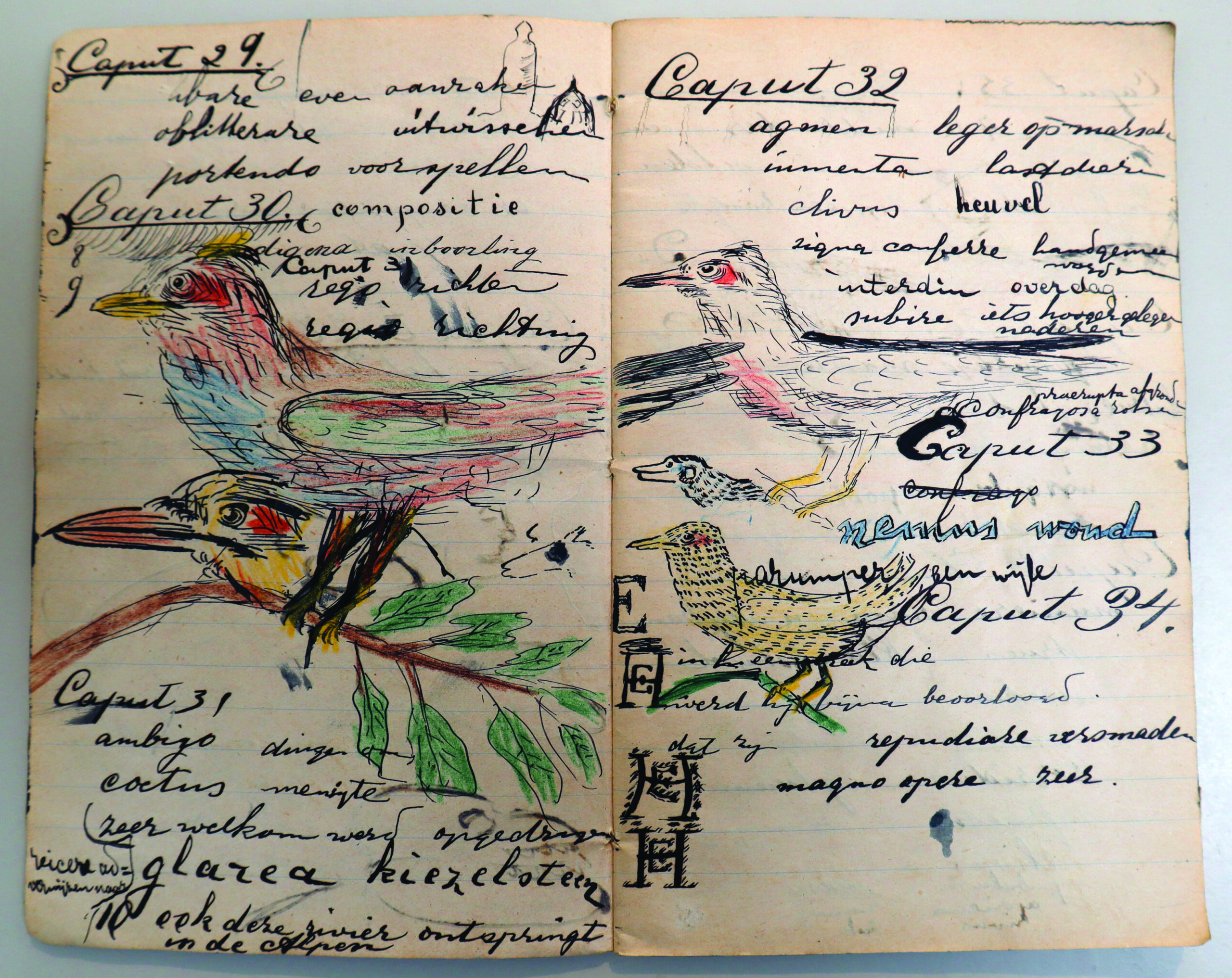
Due to his father's health problems, Edmond had to abandon his studies in 1919 to help out at the company. This is where Edmond's creative mind found its place. He improved production methods, devised techniques for reusing waste materials, and explored new applications for the chemicals used in the factory. Part of the Hustinx family's home and garden on Looiersgracht became a laboratory for Edmond's creative mind.
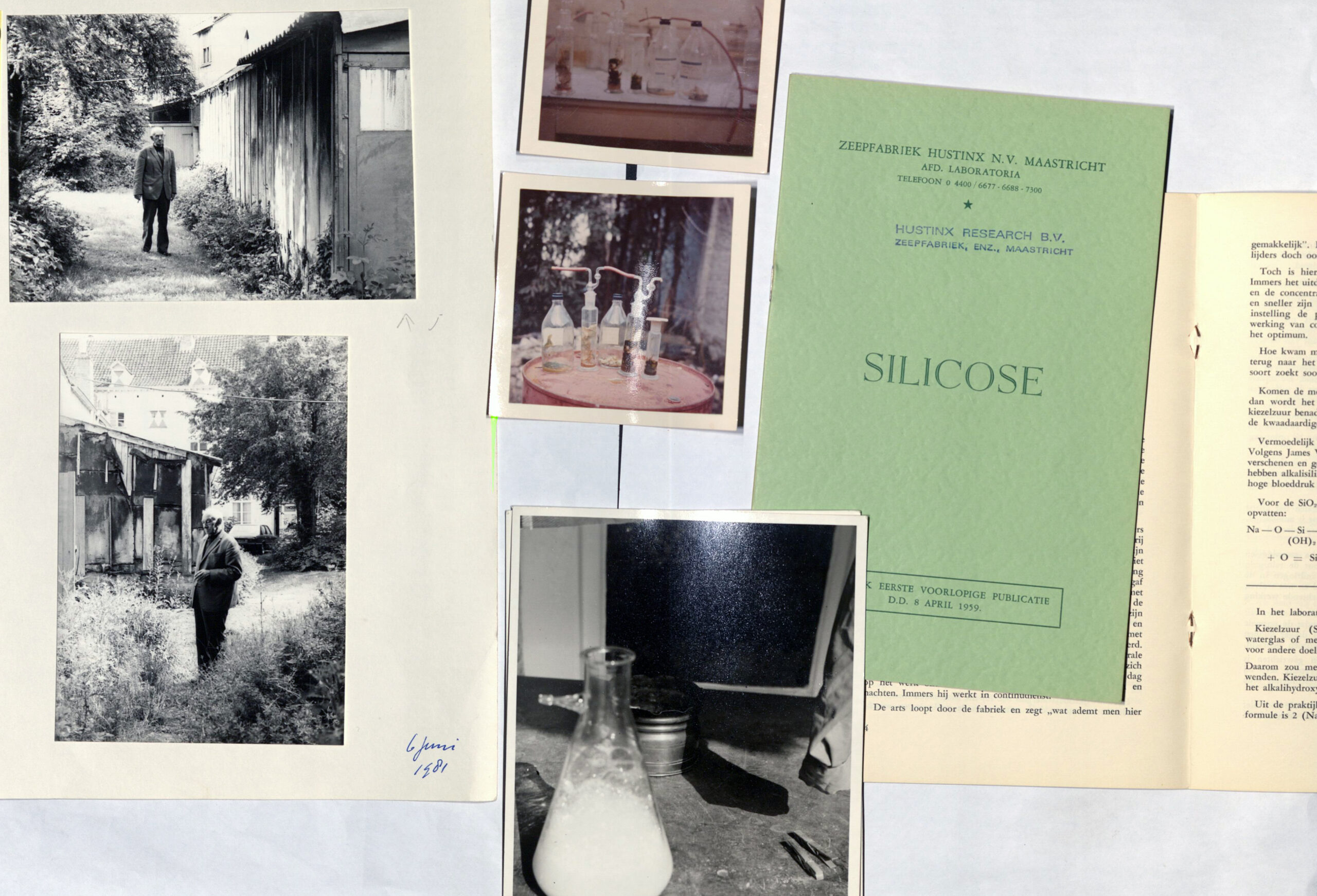
In 1931, Edmond Hustinx took over management of the soap factory from his father. By exchanging part of his parental home with the municipality, he gained access in 1943 to a large industrial estate on Lage Frontweg in Bosscherveld, in what is now Frontenpark. The old factory premises on Looiersgracht were transformed into a studio for research and experimentation.
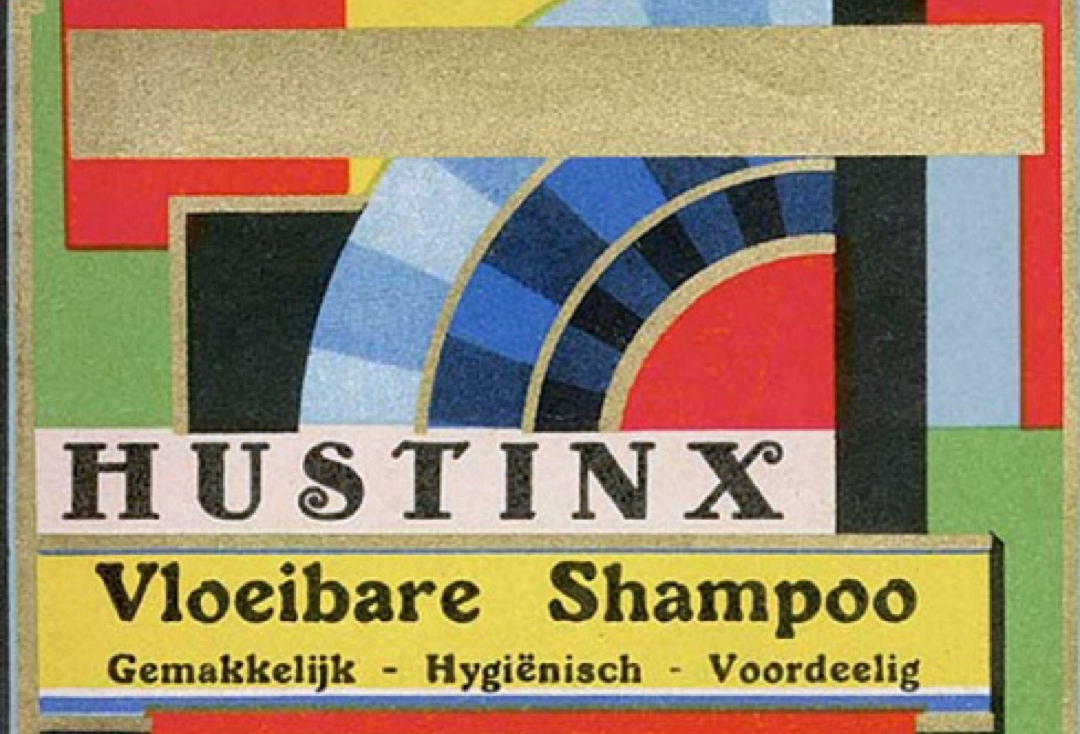
Hustinx shampoo label
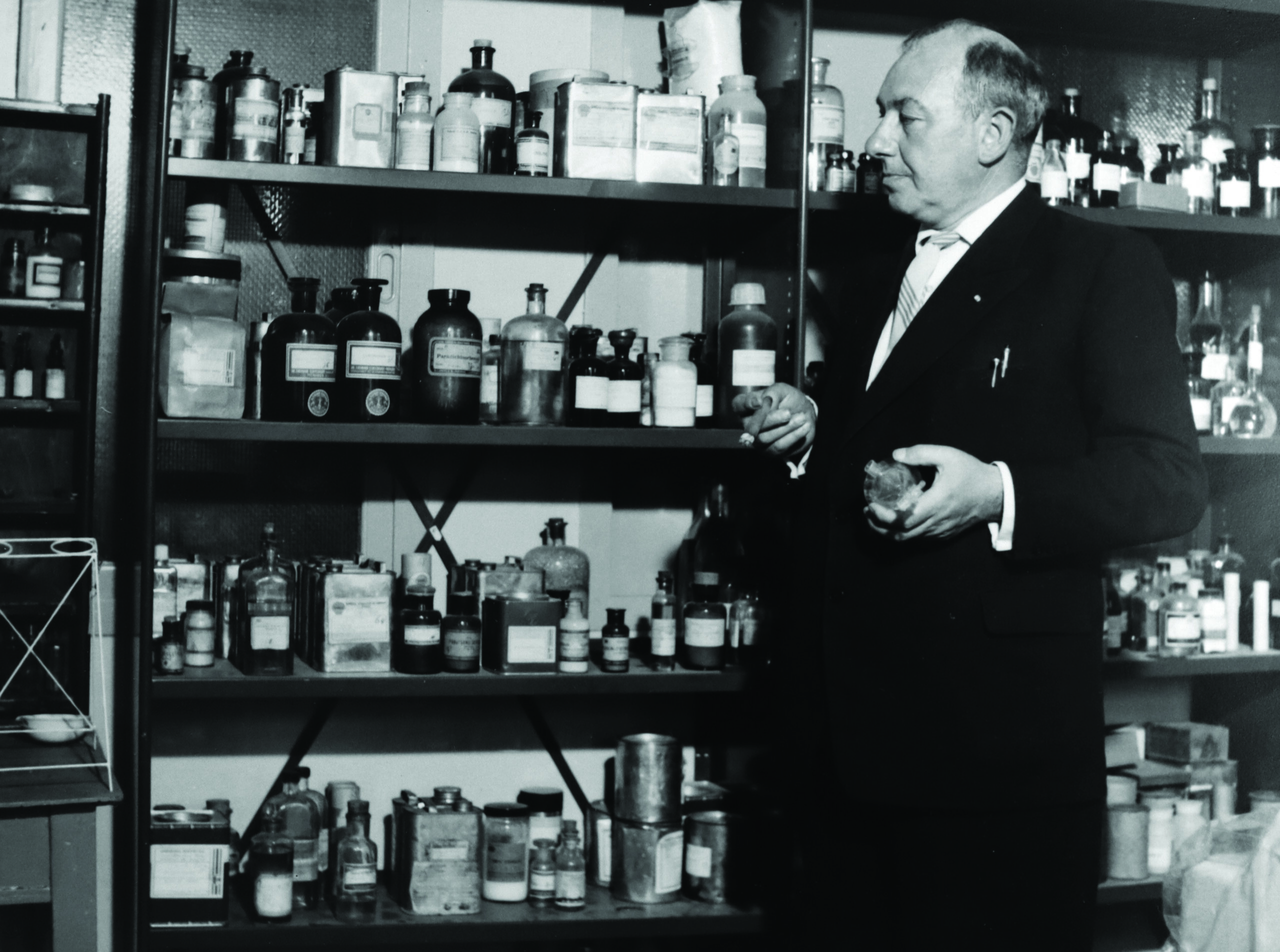
Edmond Hustinx: soap manufacturer and inventor
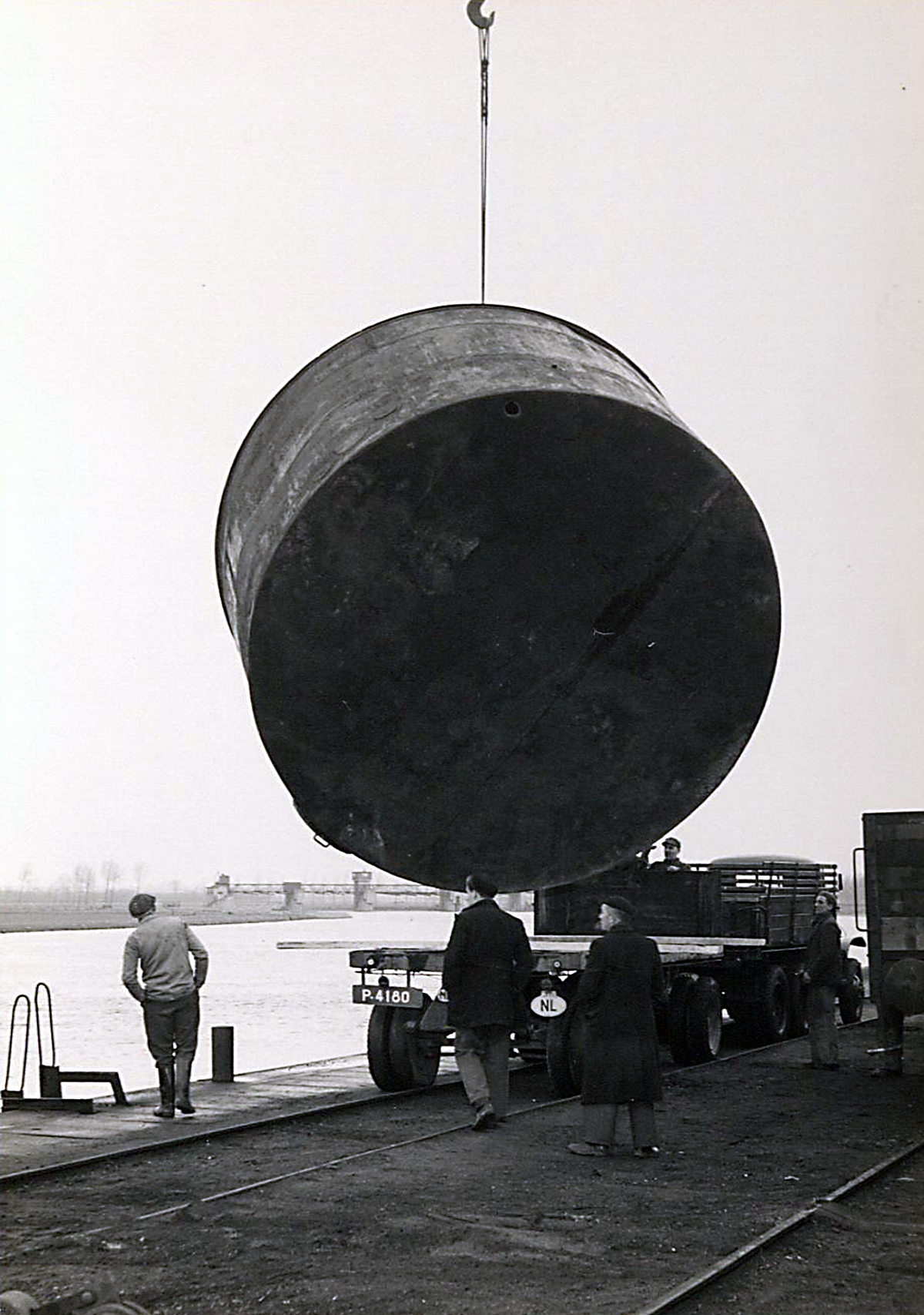
After World War II, water glass became an important raw material for the production of detergents and became one of Hustinx NV's most important products. Edmond Hustinx developed many improvements for the production of water glass, of which the rotating kiln proved to be his most lucrative invention; the patent was sold to numerous foreign manufacturers. Hustinx developed this kiln during the war when, due to scarcity, his factory was finding it increasingly difficult to obtain the raw materials for traditional soap.
The kiln was also developed due to scarcity, using common household materials. Hustinx: "A tube 40 cm long and 15 cm in diameter was sealed at both ends, fitted with a thermometer and manometer, and a hinged filling hole. The tube could be run on an old washing machine motor, powered by four pram wheels. A small gas burner was placed underneath, and after two weeks, we were able to produce water glass. With an expenditure of 500 guilders and two weeks of hard work, we laid the foundation for a new water glass production system."
Waterglass, or sodium silicate, is made, like glass, by fusing sand and soda under high temperatures. Waterglass is used as an ingredient in cleaning products, adhesives, and mounting sealants. It can also be used to waterproof concrete walls or fireproof thatched roofs. Edmond Hustinx researched and devised numerous applications for waterglass, such as preserving marlstone or extinguishing oil fires. He claims his most compelling invention for waterglass was the heat shield for NASA rockets. He supposedly suggested this idea to NASA researchers during a month-long stay in the US in 1964. However, this invention cannot be verified.
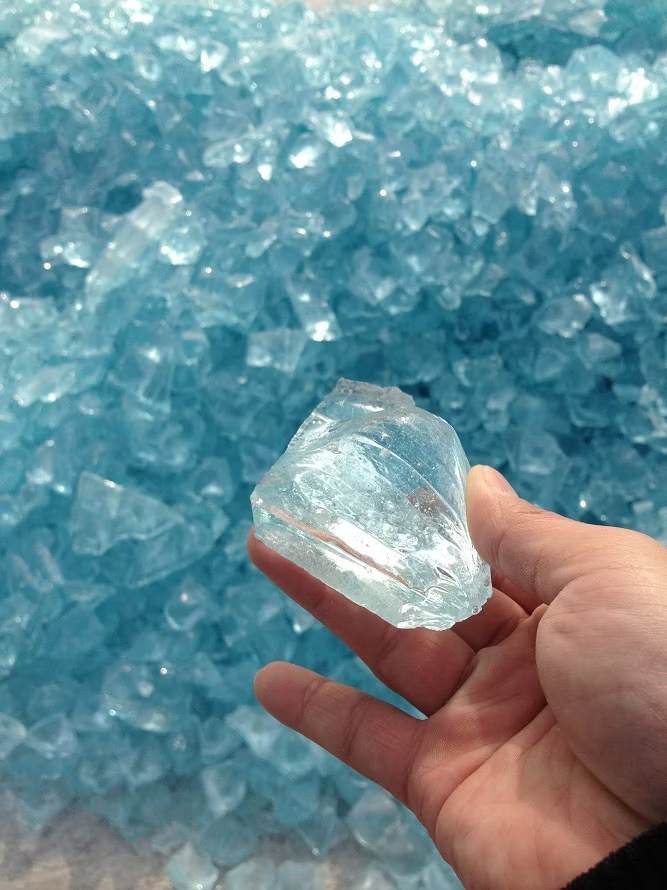
Water glass or sodium silicate
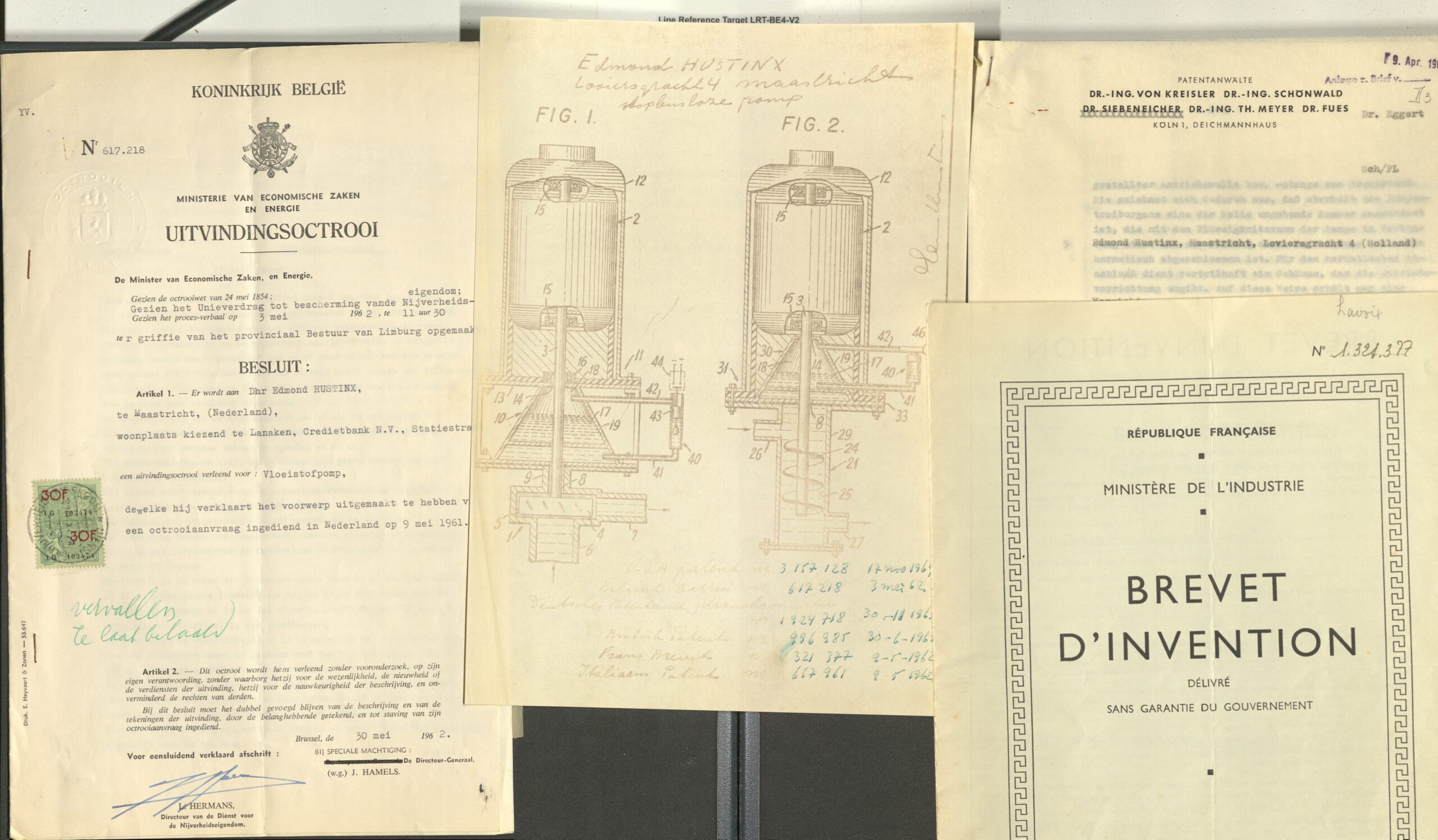
The patent application for a liquid pump that Hustinx has filed in Belgium, Germany and France
Hustinx's lifelong quest led to 1,116 inventions, patents, and patent applications, both domestically and internationally. Many relate to improvements in the manufacture of detergents, water glass, and related products. He also developed ideas and research into reusing factory waste products. The anecdotes accompanying his inventions reveal that his ideas stem from everyday observations: the ripples in a swimming pool; falling snow on a bench; or the residue left behind after a failed wash in his own washing machine.
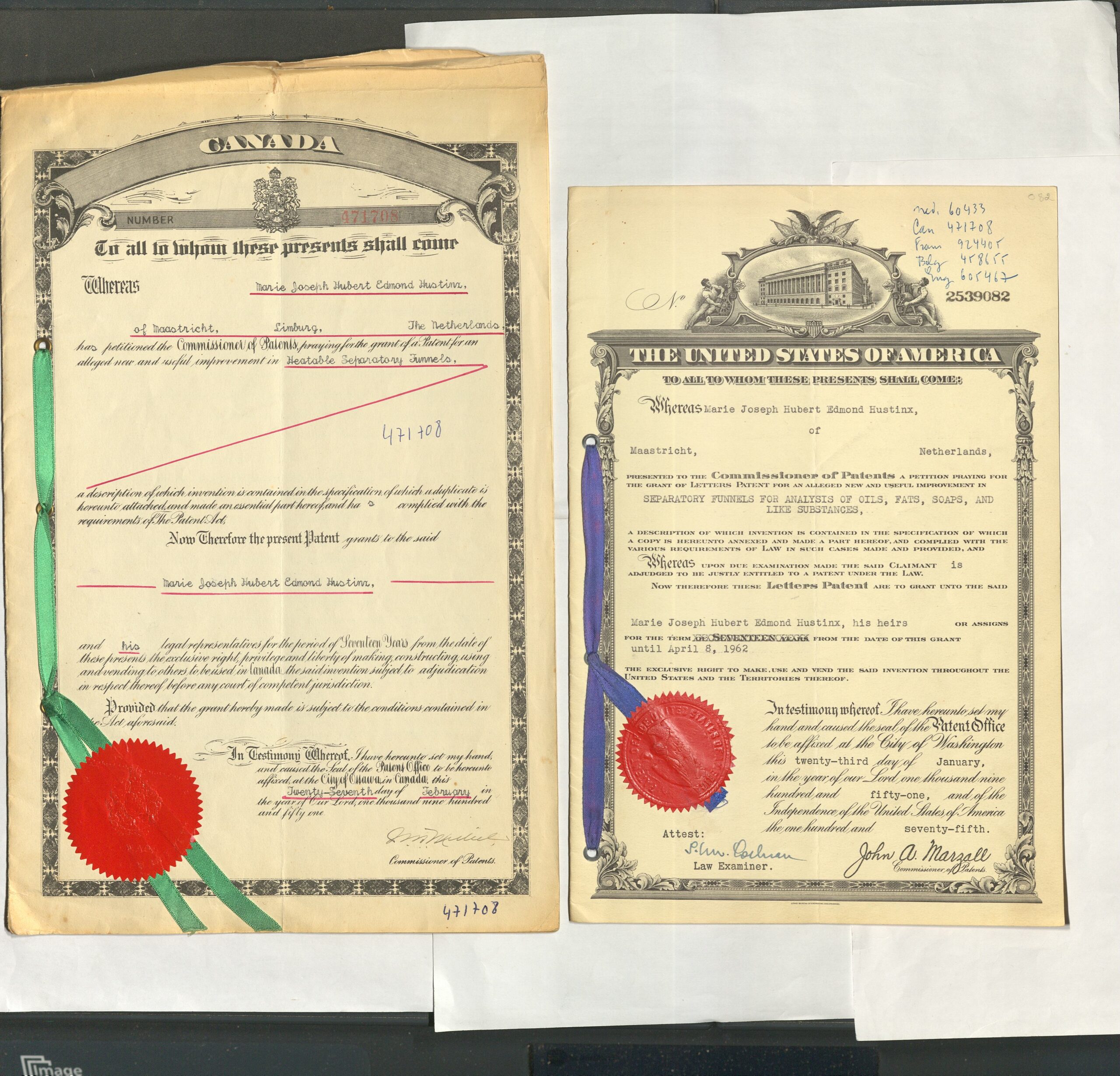
Hustinx Patent from US and Canada
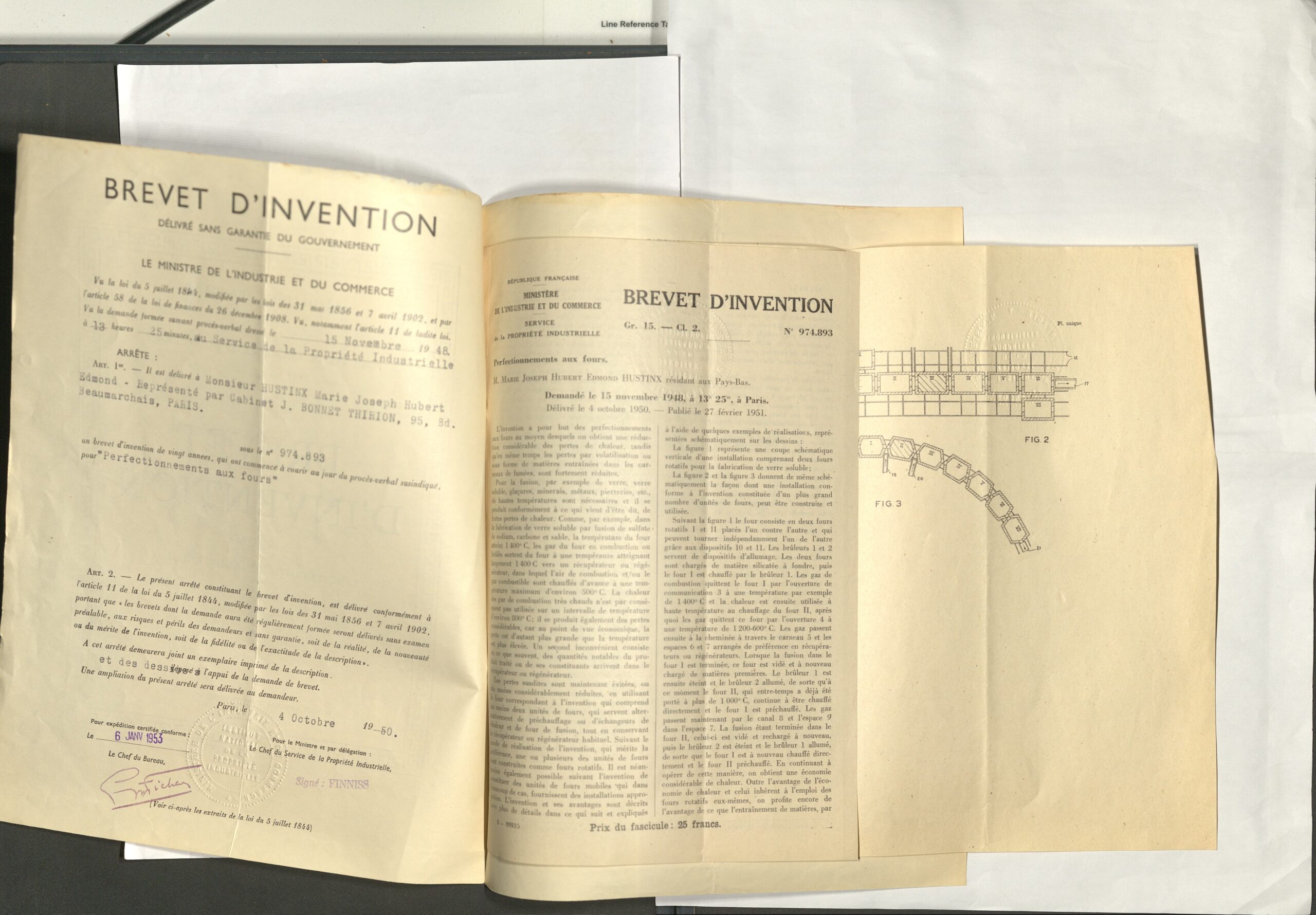
Brevet d'invention Perfectionnement aux Fours from 1950 by Hustinx
His self-compiled overview of his discoveries paints a picture of a mind constantly brimming with ideas, unconcerned with practical applicability or commercial gain. With some ideas, he was far ahead of his time; others seem to have arisen primarily from the joy of the search itself. Some of the most remarkable ideas are:
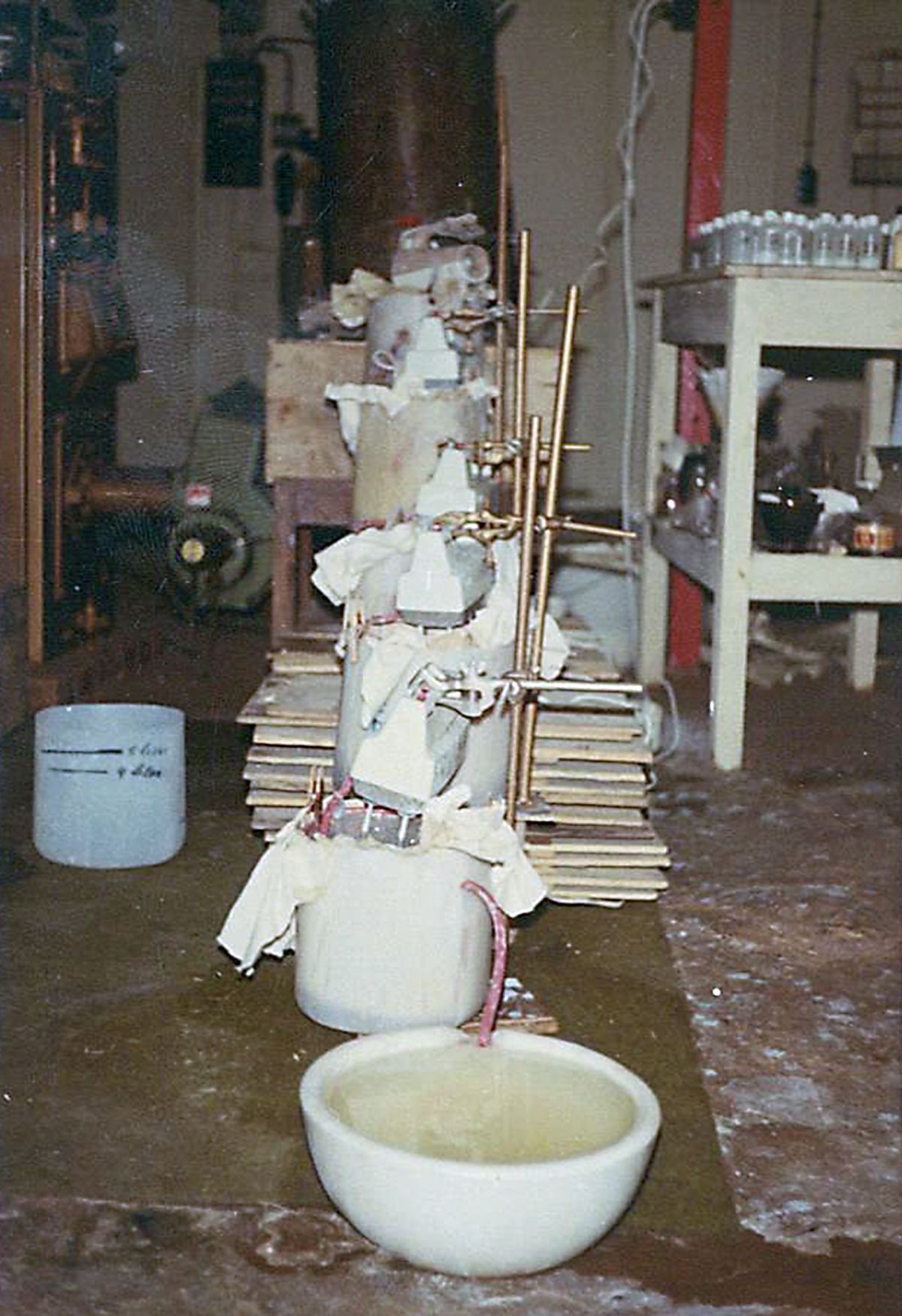
Just as he did with the invention of the rotary kiln, Edmond Hustinx experiments with many of his ideas using everyday materials. The photo shows an experiment for filtering magnesium silicate (talcum powder) using whipped cream mixers placed in series.
In 1940, Hustinx investigated how to accelerate projectiles using electromagnetic forces. He kept this idea secret until the liberation in 1944, when he shared the plan as a patent application with Eisenhower's headquarters. Eisenhower returned a thank-you letter, which Edmond, to his own frustration, lost. "Where the hell is that letter?" he noted in the margin of his list of inventions. In the 1980s, this idea led to the development of railguns by the US Navy.
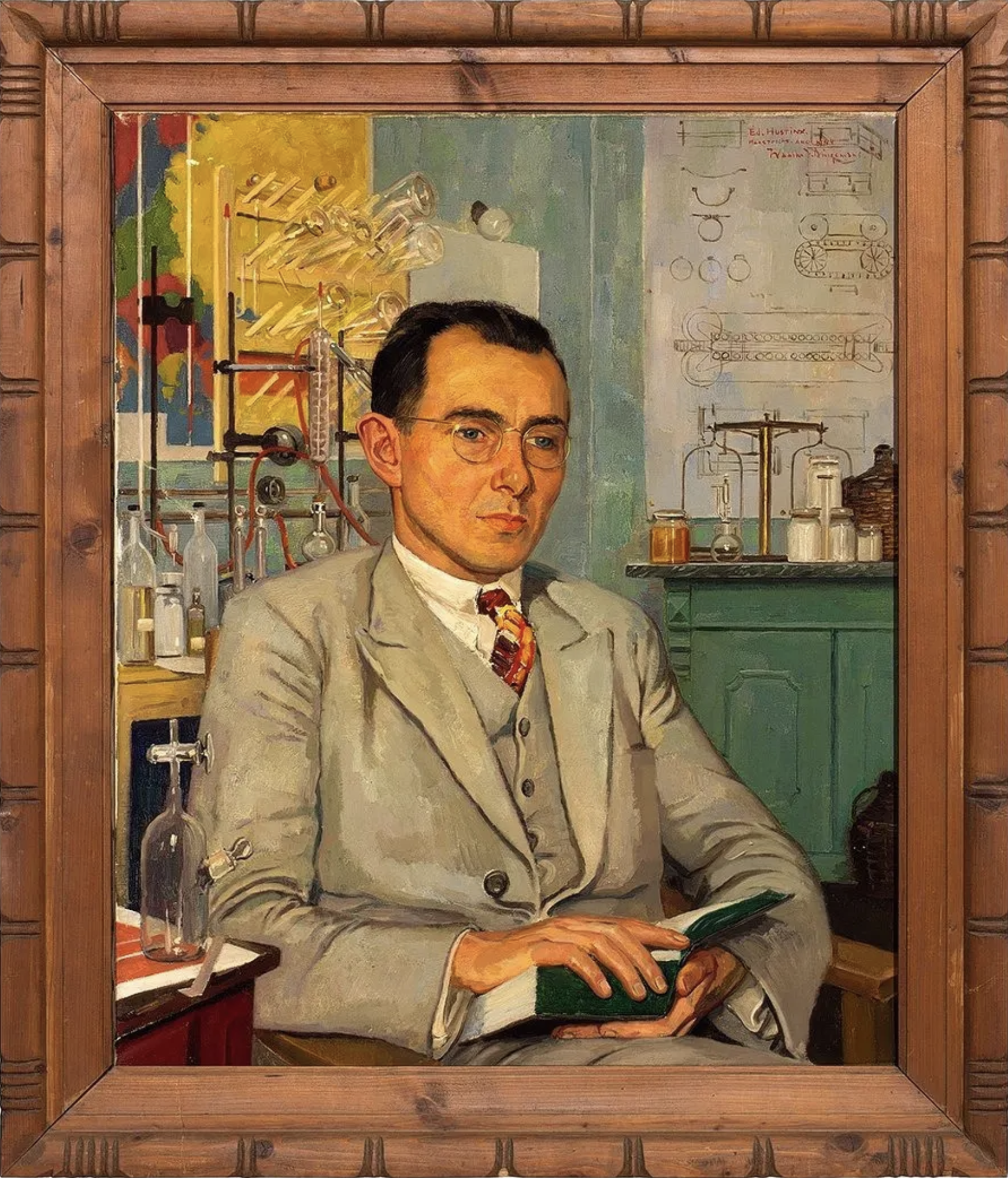
The HUSTINX flask and the MUNDUS apparatus are two tools developed by Edmond Hustinx that are practically useful for chemical research. Hustinx sold these internationally to universities and laboratories through flyers in English, German, and French.
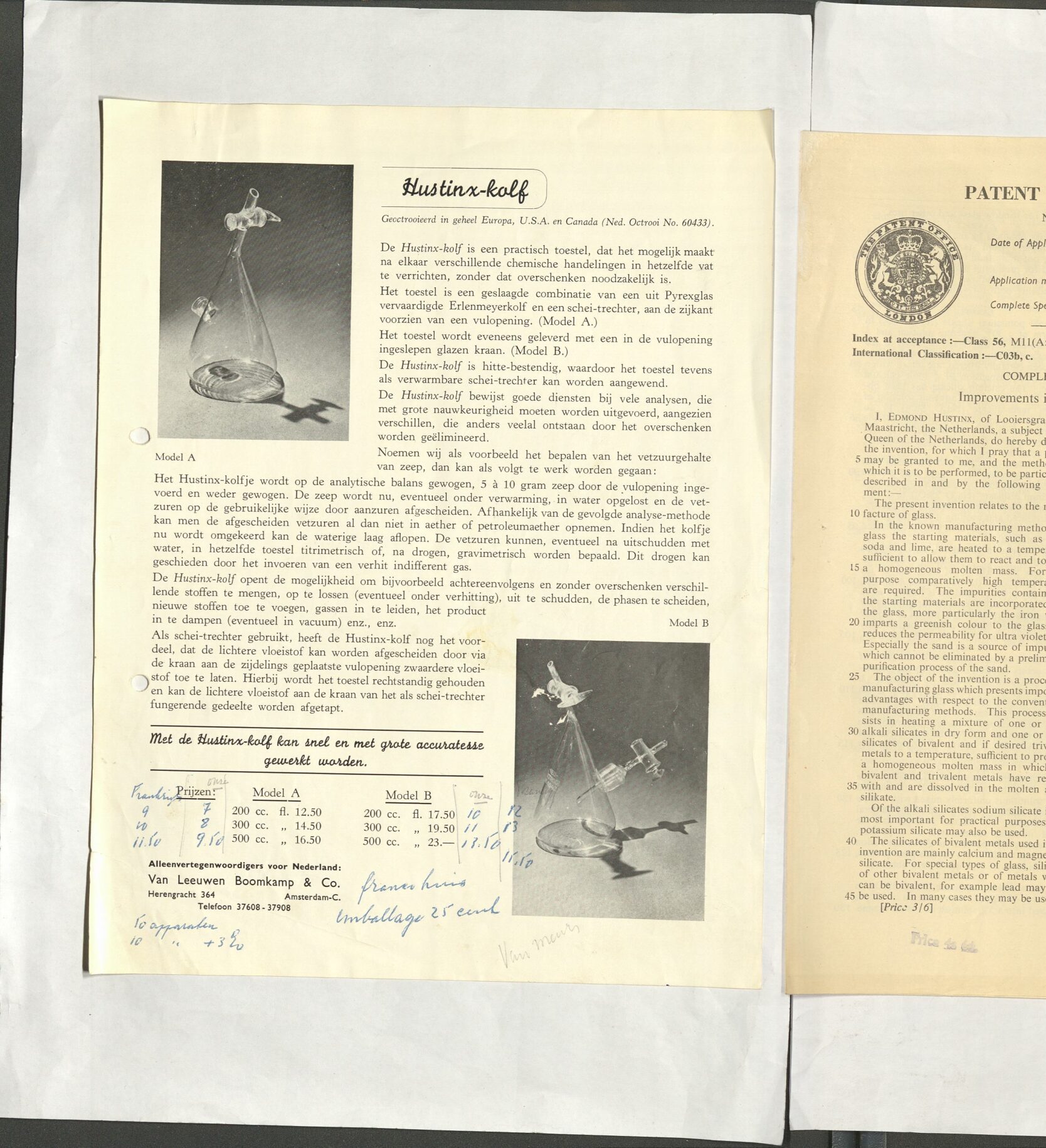
Dutch flyer Hustinx flask
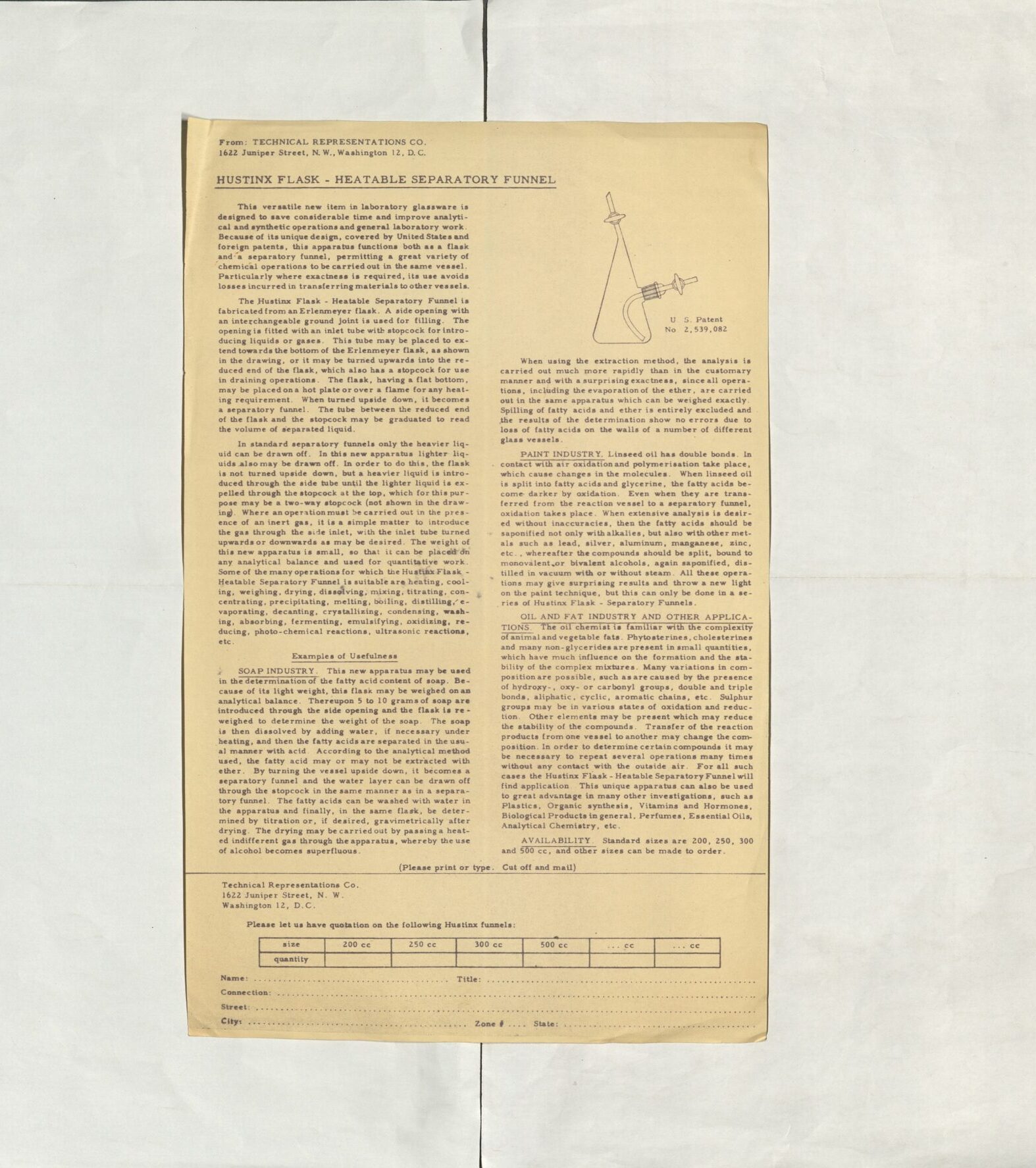
English flyer Hustinx-flask
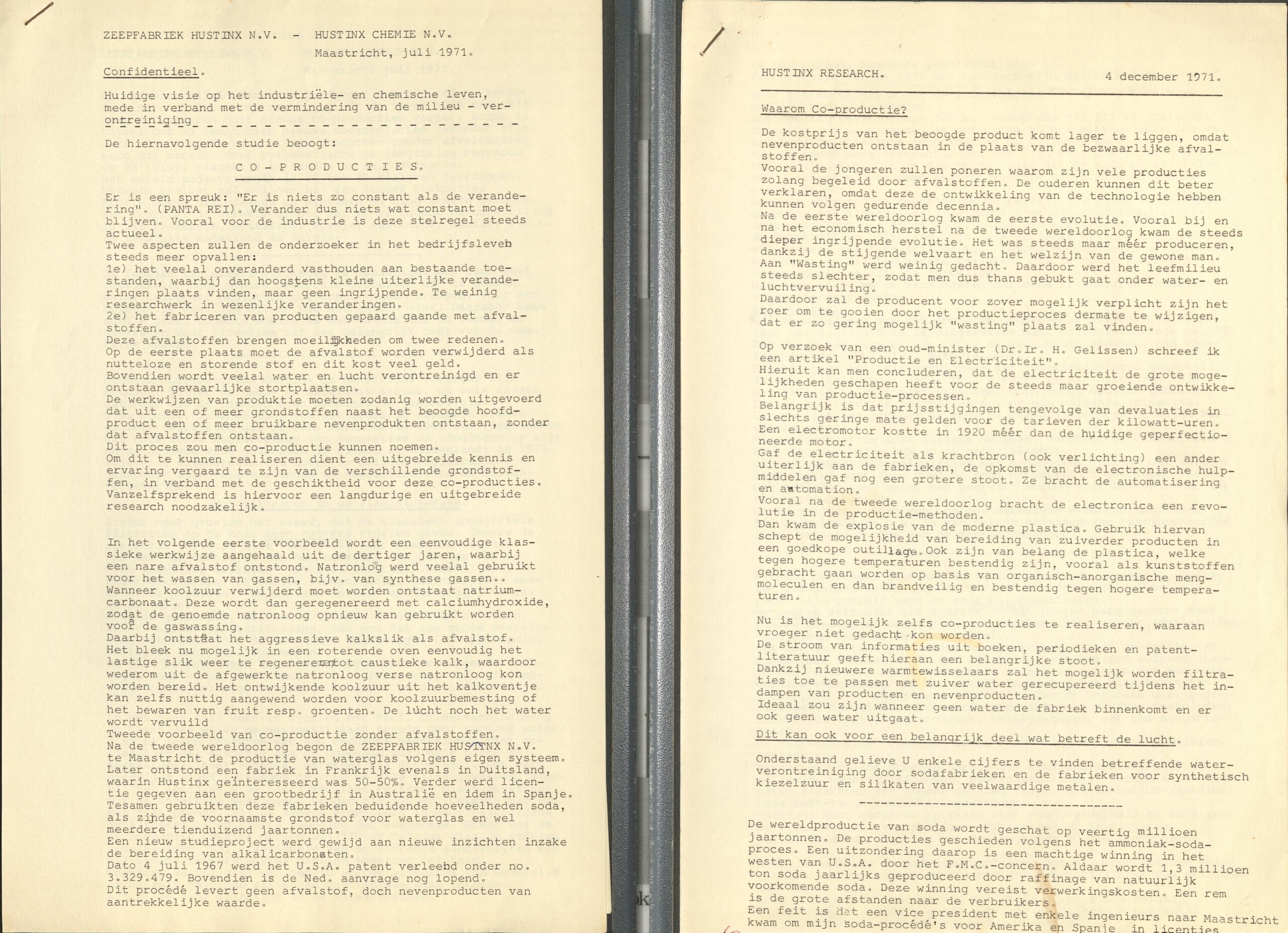
In the 1960s and 1970s, Edmond Hustinx gave a number of lectures, primarily for audiences from the chemical industry. He discussed, among other things, ways to purify industrial wastewater to improve the water quality of the Rhine and Meuse rivers, and methods to minimize air pollution. In almost every lecture, he advocated for an industry that combines production with research and experimentation. Only in this way can one truly understand the impact of the production process on the environment and how waste and pollution can be used effectively.
Chemist Frits Böttcher was one of the founders of the Club of Rome, a group of scientists and entrepreneurs who met in 1968 to raise their concerns about the environment and climate. Their 1972 report, "Limits to Growth," had a major impact on environmental awareness worldwide. It was through Böttcher that Hustinx's production methods became known within the Club of Rome as progressive in the field of sustainability. Their correspondence reveals that Hustinx initially refused to accept terms like "environmentally friendly," stubbornly clinging to the term "co-production."
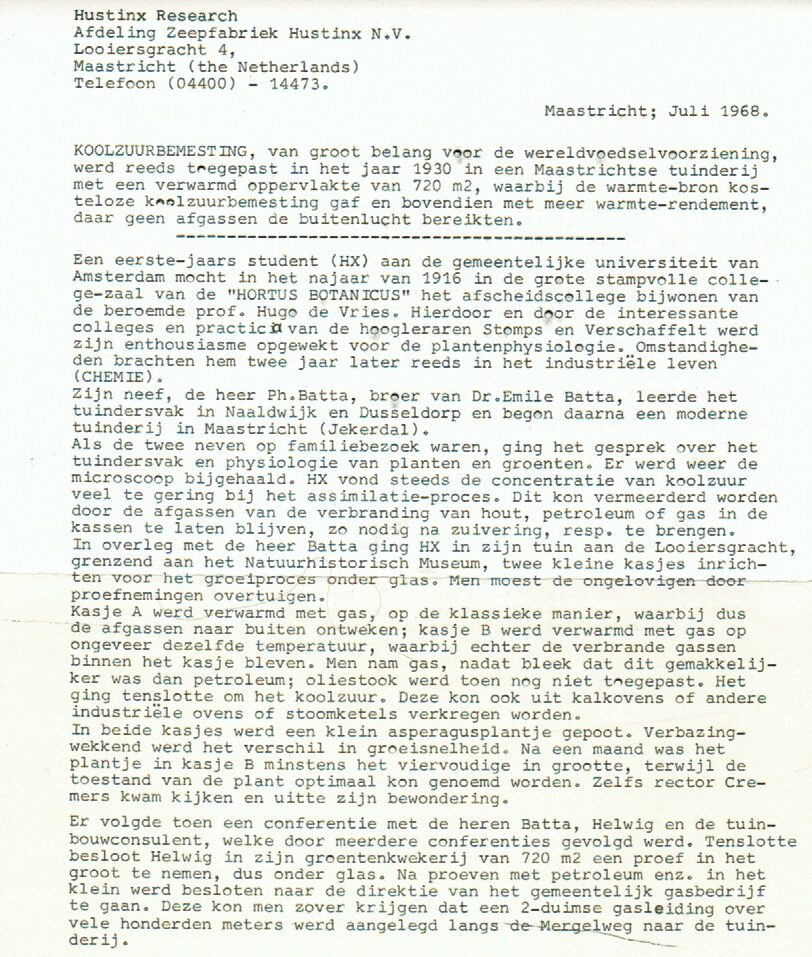
One of Hustinx's first patent applications concerns a plan to capture the CO2 released during greenhouse heating and use it as fertilizer for the plants inside. After trials with small asparagus plants in glass bottles, he is conducting a comprehensive test in a 720m² greenhouse in the Jeker Valley.
The financial crisis of 1929, however, threw a wrench in the works. The soap factory was in dire straits; Edmond applied to chemical companies across the country and used newspaper advertisements to find creditors. Some of the factory's inventory was sold. A position as head of the nitrogen fixation plant at the State Mines in Geleen provided financial leeway. However, Hustinx, as an employee, was not allowed to hold a patent, so he had to withdraw his application. In 1931, Edmond returned to the soap factory, where he applied for a Belgian patent for this invention in 1934.
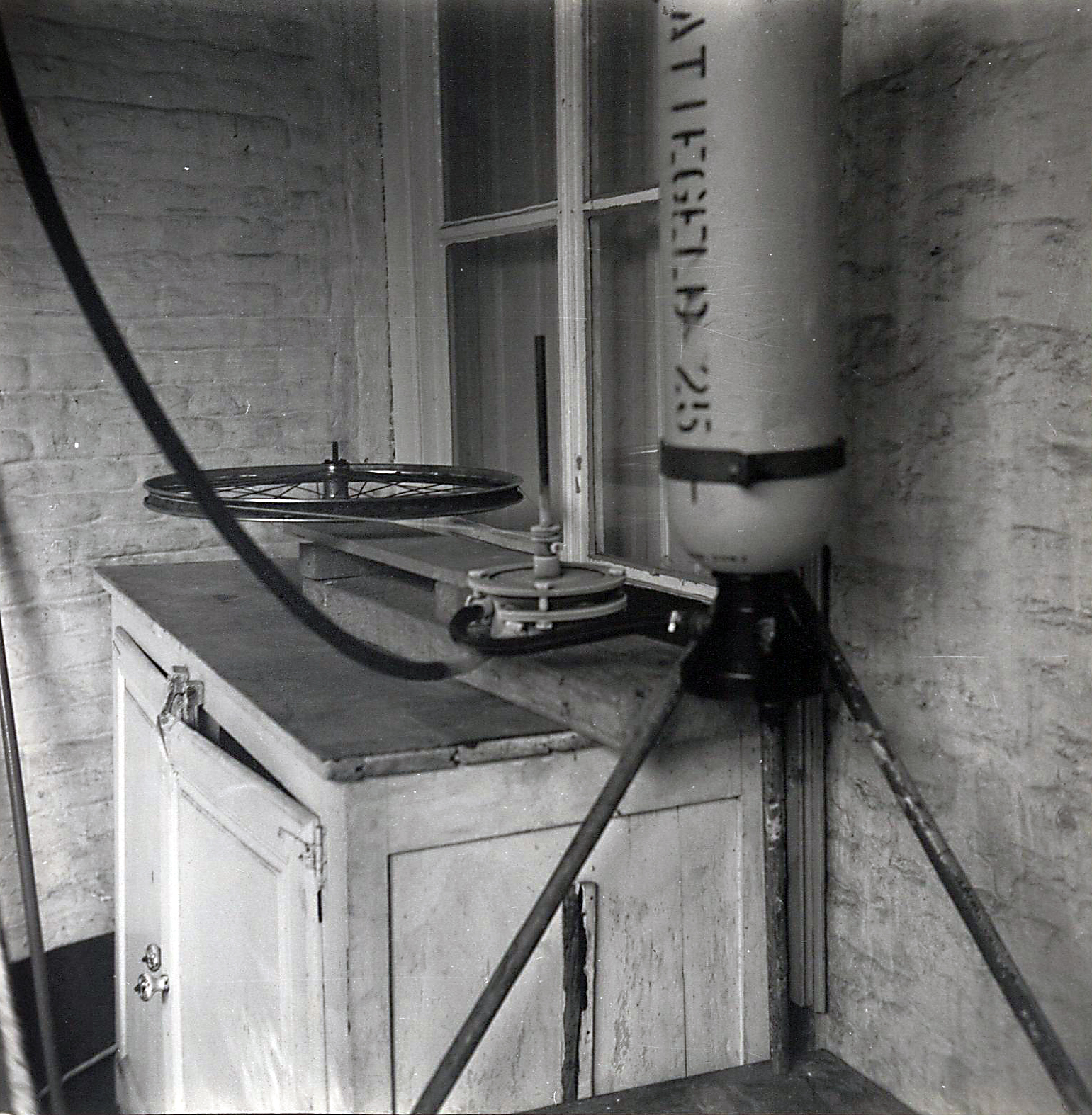
Another idea Hustinx spent a lot of time on since the 1960s is a kind of heat pump, designed to generate energy sustainably. Using old bicycle wheels and machine parts from the factory, Hustinx built a test setup in the backyard and basement of his house on Looiersgracht. Hustinx was convinced that future energy generation should come from solar energy and geothermal energy, and that science was wasting its time researching nuclear energy.
Edmond Hustinx's drawings from his teenage years clearly demonstrate his artistic talent. He continued to paint actively in later life, particularly impressionist landscapes.
During his work, Edmond drew extensively; calculations, invoices, and letters often feature small sketches in the margins. Many of the drawings collected here bear a striking resemblance to Edmond Hustinx himself.
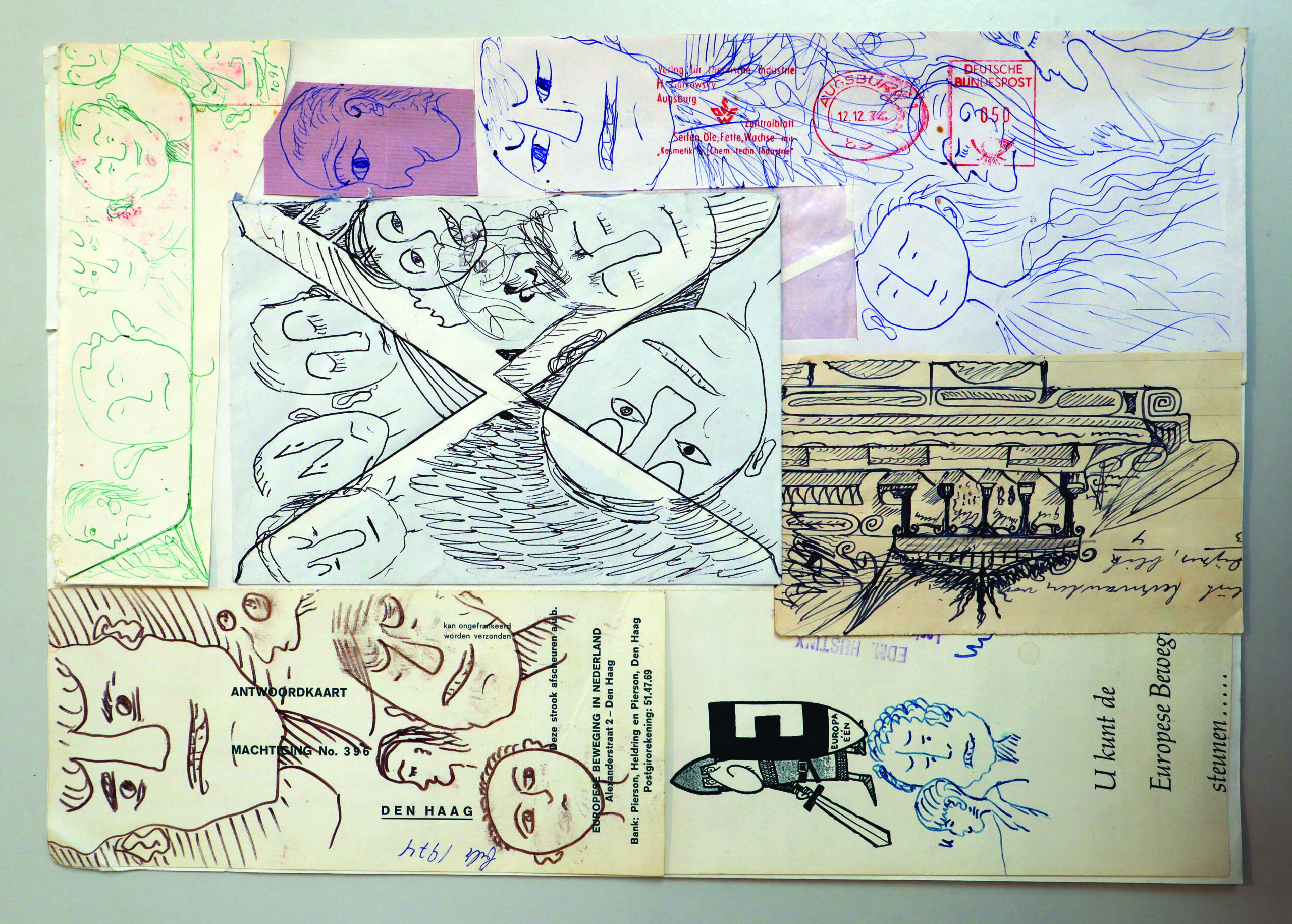
Hustinx scribbles while thinking and calling
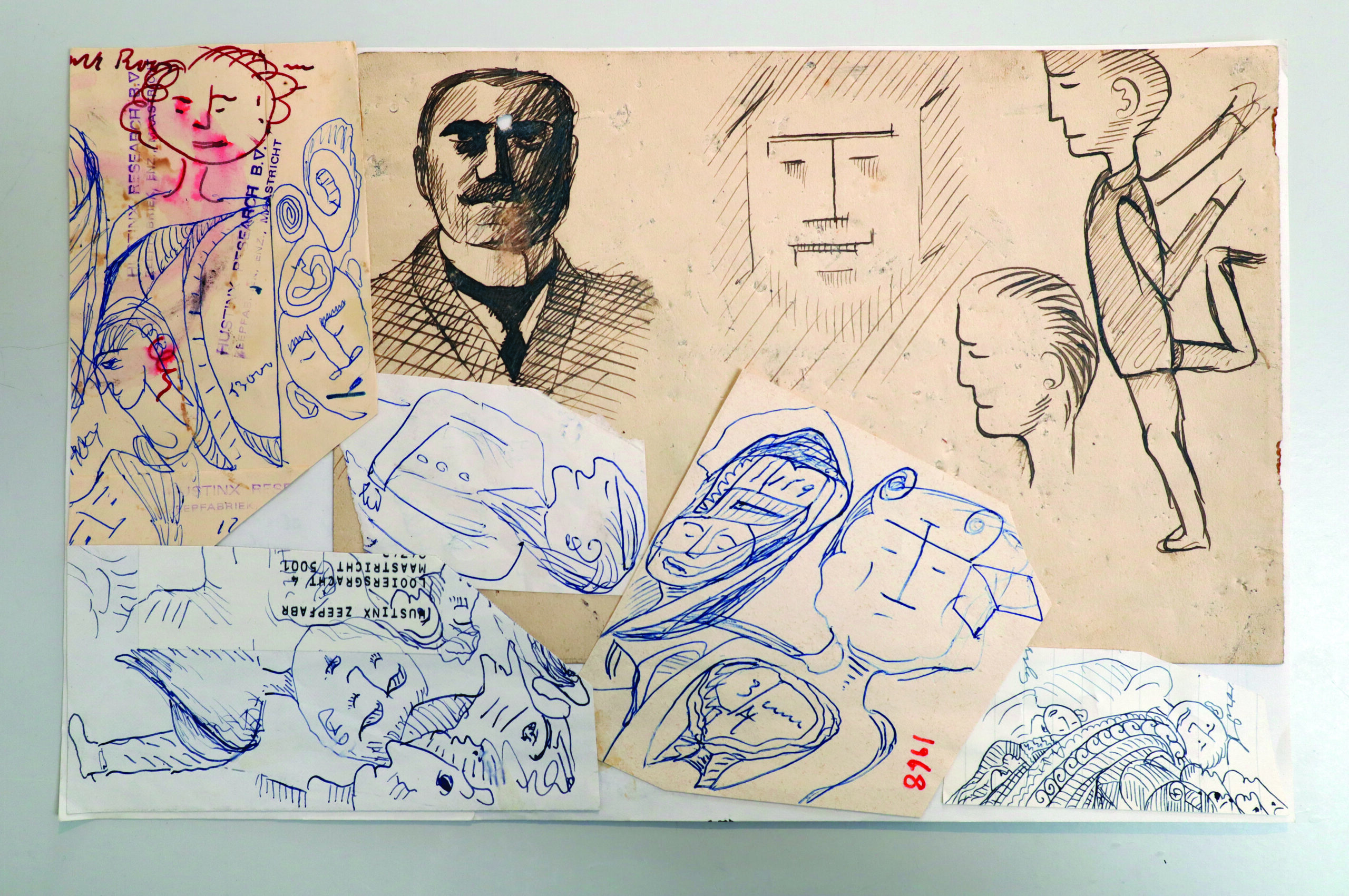
More scribbles while thinking
Hustinx's artistic interests and the factory's commercial interests sometimes intersect in remarkable ways; for example, in 1959, Zeepfabriek Hustinx NV published a booklet entitled "61 Poets and the City of Maastricht." Hustinx had the cover designed in the colors of water glass. Pie (Peter) Debye, the Maastricht-born Nobel Prize winner and personal friend of Hustinx, sends a thank-you note from New York for this book: "Many thanks for this booklet (...) which does not remind me of water glass at all. I hope you will forgive me, as the director of a soap factory, for preferring not to speak of poets and water glass in the same breath."
Several of Hustinx's inventions were commercially very successful and brought him a certain prosperity. Nevertheless, Edmond continued to live in his birthplace for the rest of his life, where he led a modest life. He used his financial resources to support artists, scientists, and local initiatives. In 1961, this patronage was formalized into the Edmond Hustinx Foundation, for the promotion of art and science.
That his fame as a benefactor spread far beyond Maastricht is evident from the letters in his archive. In addition to fan mail to the "Dutch Edison," there's also a request from a 13-year-old for an electric toy train. Whether Hustinx accepted this request is unfortunately unknown.
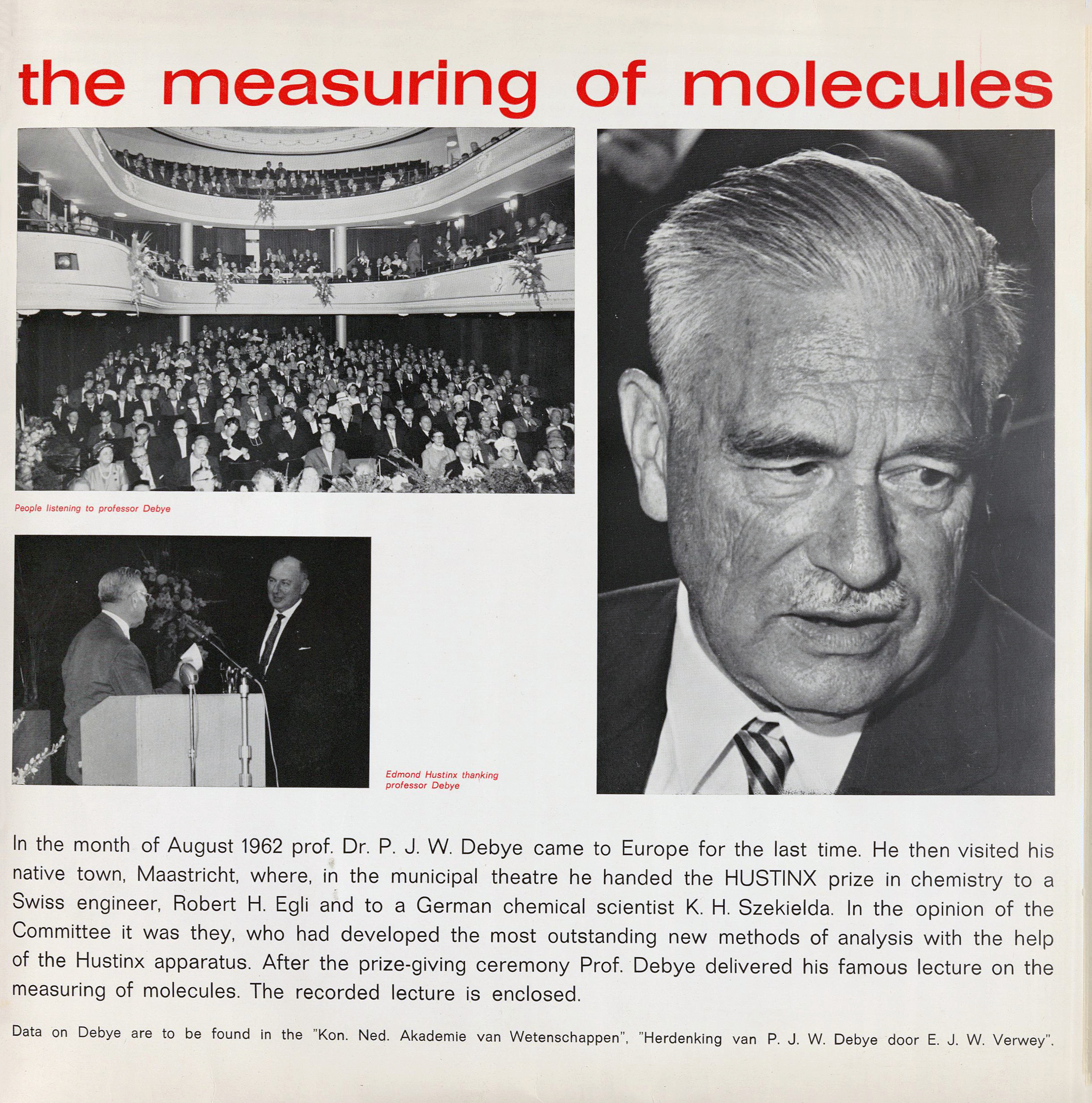
From 1937 onward, a warm friendship developed between Pie Debye and Edmond Hustinx, who wrote to each other in both Dutch and Maastricht dialect about their scientific interests. The high point of their relationship was Debye's presentation of the Hustinx Prize for Chemistry in 1962. Prior to the presentation, Debye gave a lecture at the theater on measuring molecules. Edmond had this lecture recorded, which he then sent to all his contacts worldwide. He received a folder full of letters in return, including one from the famous physicist Werner Heisenberg, one of the founders of quantum mechanics.
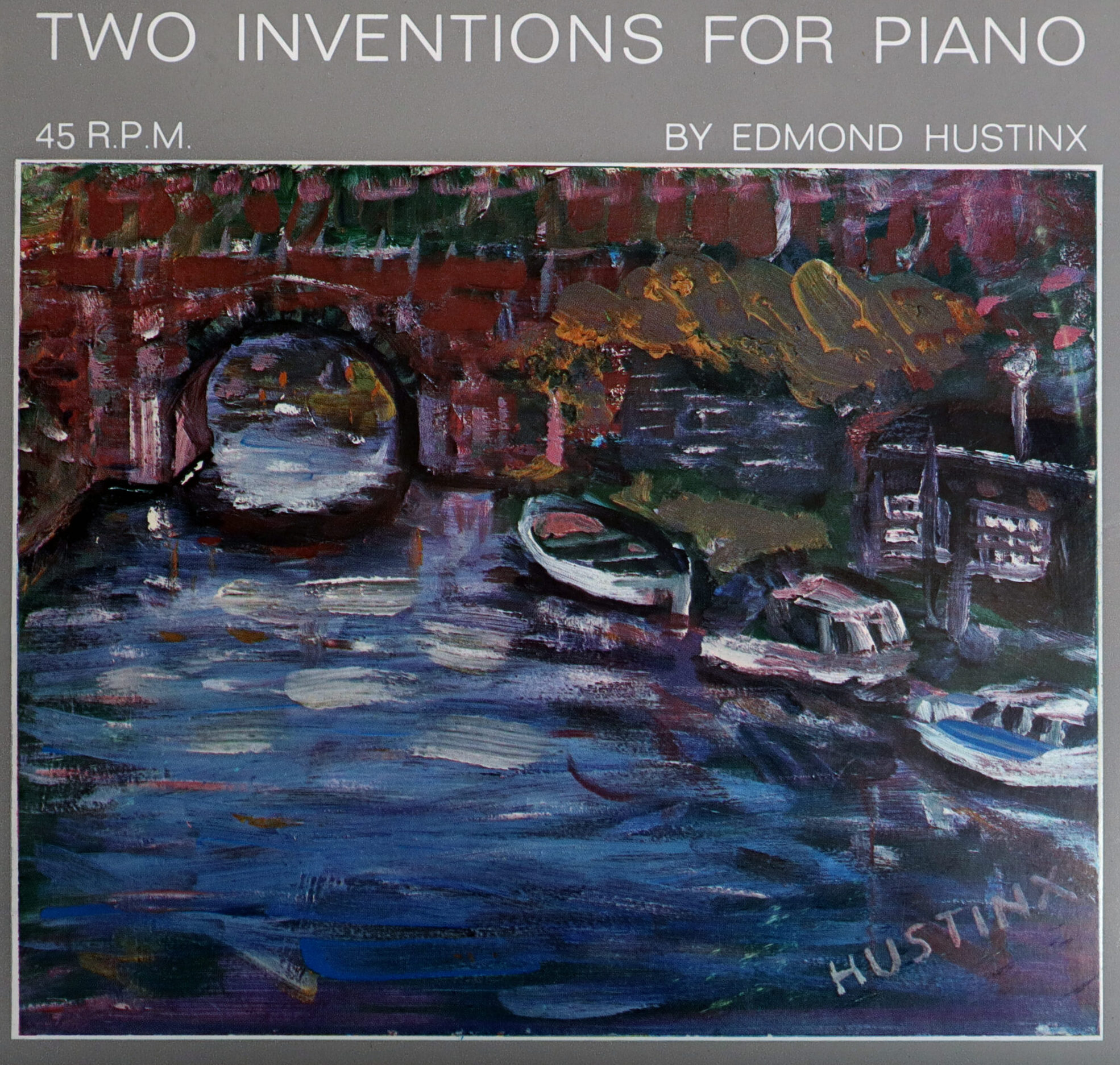
Besides science and painting, music was also a lifelong passion of Hustinx. He made numerous recordings of his piano compositions and commissioned composers to develop them further. He scribbled his ideas and frustrations on four sides of the tape covers. Comments like "Difficult case" alternate with less modest pronouncements: "Only after the year two thousand will musicians truly appreciate these ideas." One of his compositions, which quickly became clear and insightful after a heavy introduction, bore, according to the workers, a striking resemblance to the machines in the soap factory and was nicknamed "the water glass symphony."
Under the motto "geometry as a hobby," Hustinx attempted to solve a number of classical geometric problems. The enormous quantity of drawings and calculations in his archive suggests he worked many nights on this. This hobby/obsession began during World War II, when the factory was temporarily shut down by order of the occupying forces. Judging by the varying dates on the folders and pieces of wallpaper he filled with, he must have sometimes worked on a calculation for years.
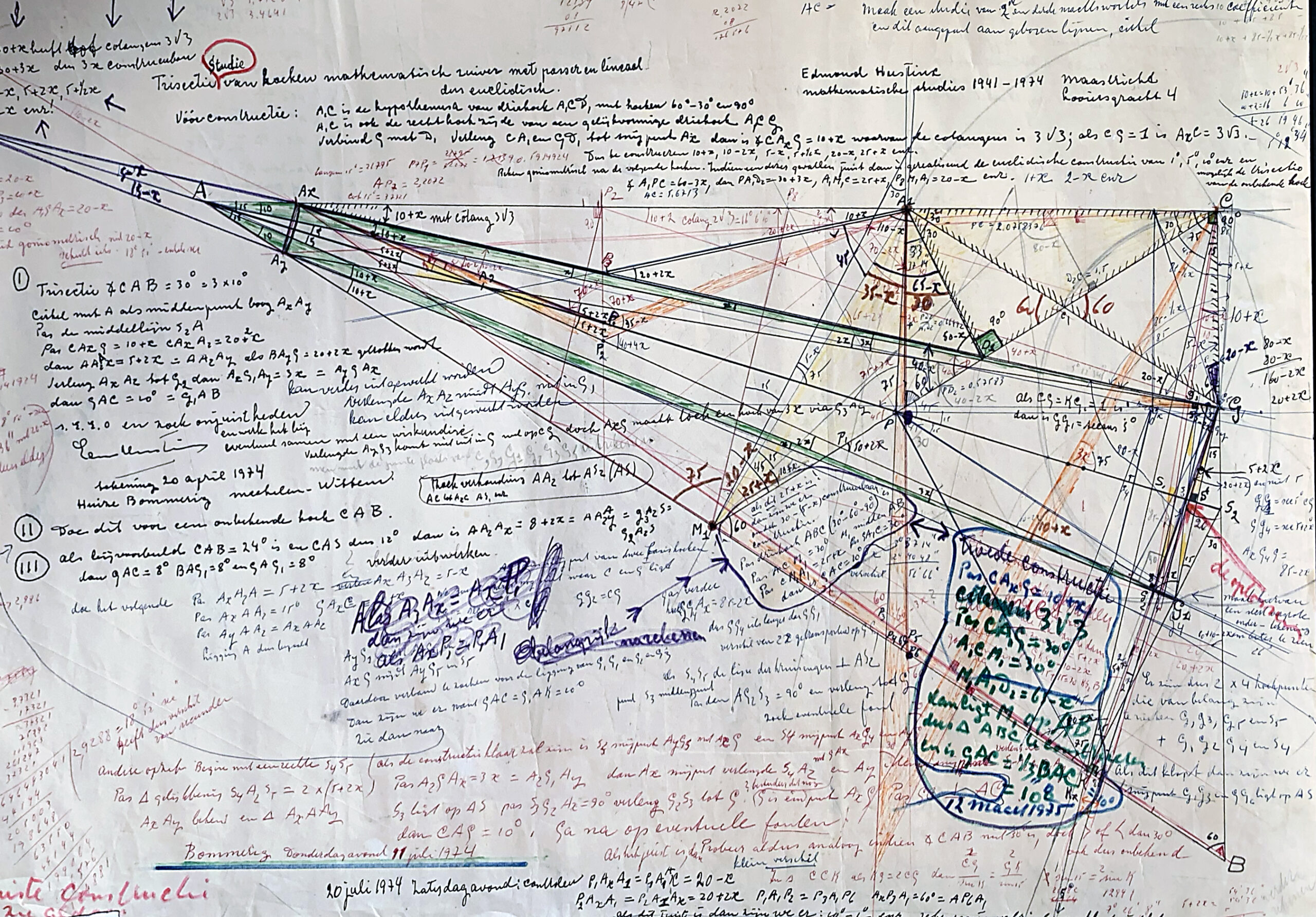
Geometry as a hobby.
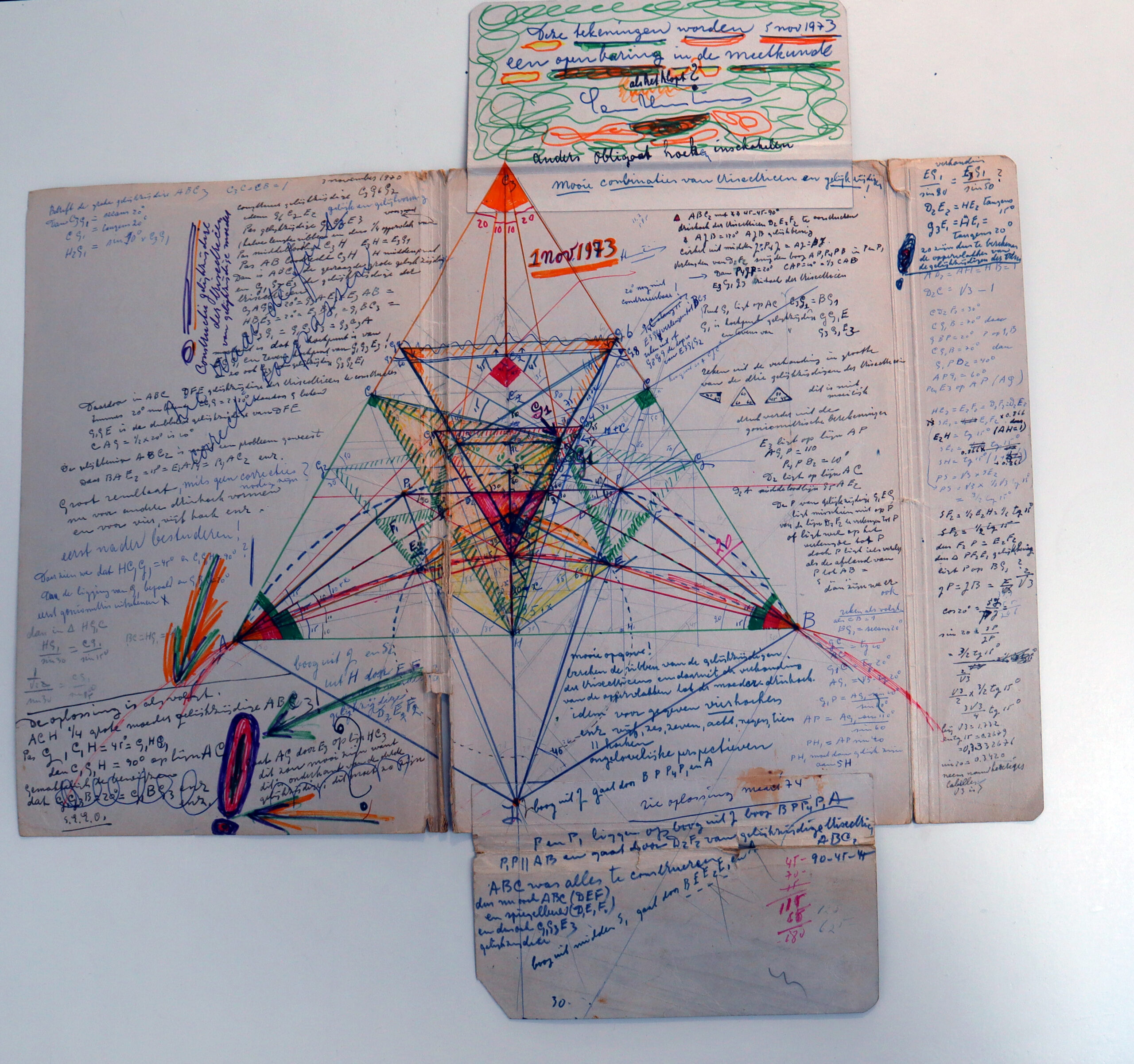
Hustinx was particularly fascinated by triangles.
Edmond Hustinx himself said in an interview: "Why geometry? Mathematicians usually live to be old; it's good for your brain." He died in 1984 at the age of 85. Even in the hospital, he was still busy with calculations and new formulas.
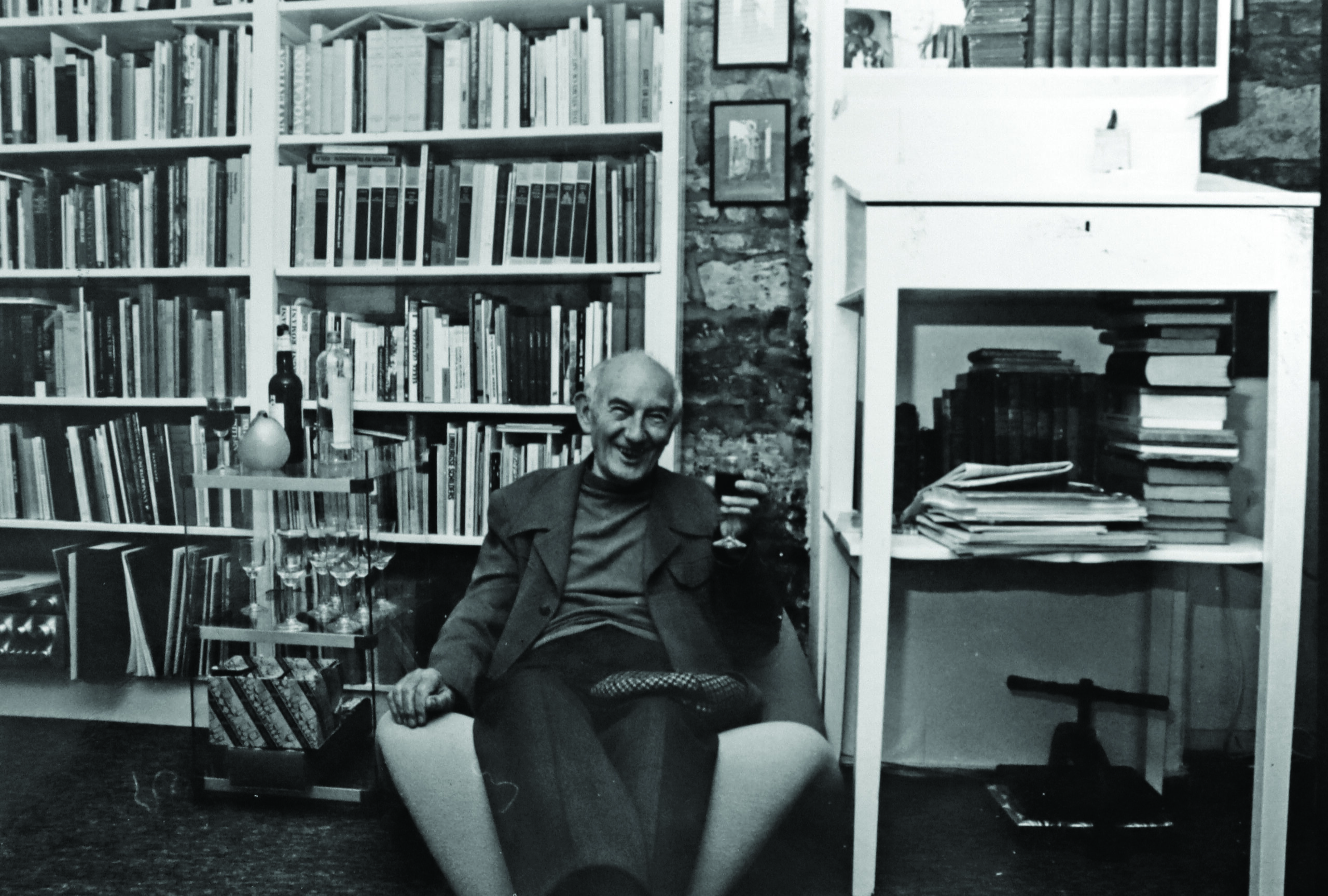
In 1986, on the occasion of the 25th anniversary of the Hustinx Foundation, the biography was published Edmond Hustinx 1898-1984 about the life, work and many passions of Edmond Hustinx.